New Zealand’s used-import sector is sometimes criticised through the language of “dumping ground”. It is a powerful phrase because it suggests waste, neglect and decay. It implies vehicles being pushed into New Zealand because no one else wants them, then left here to rot.
That picture is wrong.
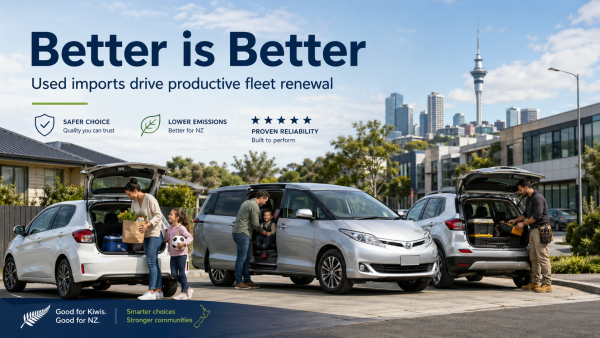
A dumping ground is where goods sit unused. The vehicles imported through New Zealand’s used-import channel do the opposite. They are bought, registered, maintained and put to work by families, workers, students, retirees, tradespeople and small businesses. They take children to school, carers to clients, shift workers to early starts and late finishes, and small-business owners across town when public transport cannot do the job.
That is not dumping. That is productive use.
New Zealand’s transport system still depends heavily on private vehicles. That may be uncomfortable for some policy debates, but it is the reality for many households. Public transport and active transport have important roles, but they do not yet meet every need. Many families live, work and study across complicated routes and irregular hours. Some households can afford only one vehicle, and that vehicle has to do everything: the commute, the supermarket run, sport, school, elderly parents, weekend trips and emergencies.
For those households, the question is not whether they would prefer a brand-new vehicle. The question is what they can actually afford.
That is where the used-import channel matters. It gives ordinary New Zealanders access to better vehicles at realistic price points. Used imports go through a rigorous inspection regime and are demonstrably better than vehicles currently in the NZ fleet of the same age and price point, much less the oldest stuff importing the car pushed out of the fleet. That is the practical test that should sit at the heart of transport regulation: does the replacement vehicle improve the fleet?
The answer is often yes.
Recent updates to Rightcar’s used vehicle safety ratings show why simple assumptions about age are not enough. NZTA’s refreshed approach draws on real-world crash data through the Used Car Safety Ratings system, using information from millions of vehicles and injured road users in police-reported crashes on both sides of the Tasman. The result is a more nuanced picture of safety performance across the fleet. Some very old vehicles perform poorly, and no one should pretend otherwise. But many used vehicles continue to achieve strong safety ratings, including vehicles whose original ANCAP ratings have expired and vehicles that are now assessed through real-world outcomes rather than old test labels.
That distinction matters. Age is relevant, but age alone is not the answer. A vehicle’s safety performance depends on its design, equipment, condition, maintenance history and real-world crash outcomes. A well-selected used import can be a significant improvement over an older, higher-risk vehicle already in the fleet.
The same point applies to emissions. Used imports entering New Zealand are, on average, materially lower in CO₂ than the existing fleet. They also compare favourably with the new-vehicle market, which is shaped by different buying patterns. New vehicles play a critical role in introducing technology into the fleet, but that market has a strong corporate and business component and a higher share of larger vehicles, including utes and SUVs.
The used-import market serves a different part of New Zealand. It is the affordability channel. It is where many households access hybrids, efficient petrol vehicles and increasingly advanced safety technology at prices they can manage. If policy makes that channel too difficult or too expensive, the result is not a sudden shift to brand-new low-emissions vehicles, it is simply holding on to the existing stuff. For many households, that would be the only other option. The result being on the fleet - slower turnover, with people holding onto older vehicles for longer.

That would be a poor outcome for safety and emissions.
This is why New Zealand needs a more even-handed approach to vehicle regulation. Entry standards matter, and VIA does not argue for weak standards. But regulation should focus on real-world fleet improvement, not on treating used imports as a problem category by default.
The better question is: are the vehicles coming in better than the vehicles staying behind?
If the answer is yes, then the regulatory system should support that improvement. It should make it easier for New Zealanders to move out of older, higher-emitting, lower-safety vehicles and into better ones. That means recognising the value of the used-import channel as part of fleet renewal, not treating it as an inconvenience.
It also means putting more attention on the in-service fleet. A vehicle is not frozen in time when it crosses the border. Its safety and emissions performance depend on how it is maintained, repaired and tested over its life in New Zealand. If policymakers are serious about better outcomes, then more effort should go into ensuring vehicles remain safe and clean while they are on the road.
That points to a broader fleet-management approach:
- maintain robust entry checks for vehicles coming into New Zealand;
- improve in-service emissions monitoring, especially where emission-control systems may have deteriorated or been tampered with;
- ensure WoF and maintenance settings support ongoing safety;
- give consumers clear, current safety and emissions information;
- identify the worst-performing vehicles in the fleet; and
- create practical pathways for those vehicles to be replaced by better ones.
That is a more sensible approach than continually tightening the entry gate while leaving the poorest-performing in-service vehicles largely untouched.
The used-import sector should be judged by what it actually does. It renews the fleet. It improves affordability. It gives families and small businesses access to vehicles that meet their real needs. It helps lower average emissions by replacing older vehicles with cleaner alternatives and supports better safety outcomes as well.
New Zealand does not need slogans about dumping grounds. It needs a practical fleet-improvement strategy.
The principle should be simple: better is better.
A safer, cleaner, well-maintained used import is not a problem to be managed out of existence. It is part of the solution.