EV chargers are welcome. But they are only one event in the fleet policy pentathlon
The Government’s latest EV charger announcement is a useful move. More public charging points will help fill gaps in the network, improve driver confidence, and make electric vehicles a more practical option for more New Zealanders.
That is all to the good.
But chargers are not the whole answer. They are one part of a much wider transport and fleet challenge. If policy focuses too heavily on one issue at a time, it risks missing the larger picture. And in New Zealand, that larger picture matters.
Too often, transport policy narrows in on the entry point for vehicles and treats that as if it is where the whole job begins and ends. It does not. A lower-emissions fleet is not built simply by encouraging a certain type of vehicle at the point of sale or import. It is built by managing the whole fleet, from entry to use to exit, while recognising that people need practical and affordable transport at every stage.
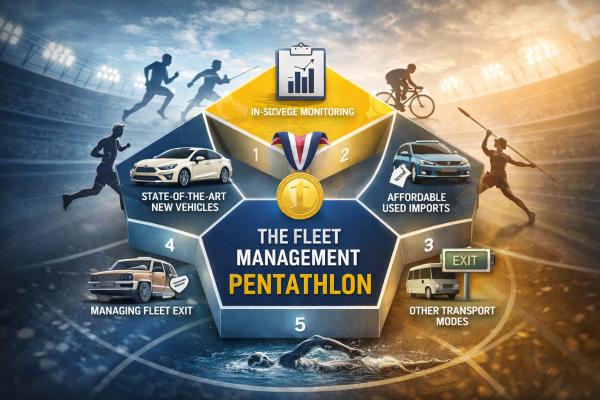
That is why VIA sees the issue less as a sprint and more as a pentathlon. Success does not come from winning one event. It comes from performing well across all five.
1. Bring in state-of-the-art low-emission new vehicles
New vehicles matter because they are the leading edge of technology. They bring the latest advances in emissions performance, battery systems, fuel efficiency, safety features, and vehicle design into the market.
That is an important part of fleet improvement. A healthy transport system needs a steady flow of newer, cleaner, more advanced vehicles entering the fleet.
But that is only the first event.
2. Make better vehicles affordable through used imports
For most households, the question is not whether they would like the latest low-emission technology. The question is whether they can afford it.
That is where used imports play a vital role. They take technology that was once available only to higher-income buyers and make it available to everyday New Zealanders at a more realistic price point. In many cases, that means a family can move from an older, less efficient vehicle into something cleaner, safer, and better suited to modern expectations.
It may not always be a brand-new EV. It may be a hybrid. It may be a smaller and more efficient petrol vehicle. It may be a later-generation used EV where supply exists.
That still matters.
Progress does not only happen when someone buys the newest thing on the market. Often it happens when people are able to step into something meaningfully better than what they already have.
3. Monitor the in-service fleet properly
This is the part of the conversation that often gets ignored.
It is not enough to look at what enters the fleet. We also need to understand what happens once vehicles are on the road. Which vehicles are doing the highest mileage? Which parts of the fleet are improving, and which are not? Are emissions outcomes improving in practice, or only on paper? Are lower-emission vehicles reaching the parts of the market where they can make the greatest difference?
A serious fleet strategy needs proper in-service monitoring. Without that, policy risks becoming too focused on labels, categories, and announcements, rather than on the actual performance of the transport system.
4. Have a real strategy for fleet exit
This is one of the weakest parts of the current policy discussion.
A cleaner fleet is not achieved simply by bringing in better vehicles. It also requires older, dirtier, less safe vehicles to leave the fleet in a sensible and timely way.
If policy makes replacement harder, slower, or more expensive, people will often do the only thing they can do: hold on to older vehicles for longer. That is not a theoretical concern. It is exactly what happens when affordability is squeezed and supply is constrained.
A proper fleet strategy must ask:
- what is entering the fleet
- what is staying in the fleet
- what is leaving the fleet
- and what is preventing healthy turnover
Turnover is one of the keys to progress. If turnover slows, the whole system slows with it.
5. Encourage other transport modes where they make sense
Not every transport challenge should be solved by changing the vehicle in the driveway.
In some places and for some journeys, better public transport, walking, cycling, car sharing, or smarter freight planning may deliver better results than a narrow focus on vehicle technology alone. New Zealand has different communities, different distances, and different transport needs. A realistic policy framework should recognise that.
This does not mean private vehicles are unimportant. Far from it. For many households and businesses, they remain essential. But it does mean that transport policy should be broad enough to support multiple paths to better outcomes.
The real lesson
The EV charger announcement is a good example of both the opportunity and the limitation of modern transport policy.
It is a sensible step. It tackles a real issue. It should help.
But a charger does not make a vehicle affordable. It does not create supply where supply is tight. It does not tell us whether the existing fleet is improving in real-world use. It does not, by itself, move older vehicles off the road. And it does not solve the wider challenge of giving New Zealanders access to practical, lower-emission transport at prices they can actually manage.
That is why Government needs to think like a fleet manager, not just a policy announcer.
A fleet manager looks at the whole system:
- new technology entering the market
- affordable diffusion of better vehicles through used imports
- performance of vehicles already in service
- incentives for older vehicles to exit
- and the role of other transport modes alongside the vehicle fleet
That is the wider approach New Zealand needs.
More EV chargers are welcome. But they are only one event in the pentathlon. If we want a cleaner fleet that is also affordable, practical, and fair, policy has to show up for all five.