Check Engine - low turnover
Turnover is the key to progress: what 2025 tells us about fleet renewal
New Zealand doesn’t improve its vehicle fleet by wishing it cleaner and safer. It improves by replacing vehicles. That replacement has a simple name: turnover.
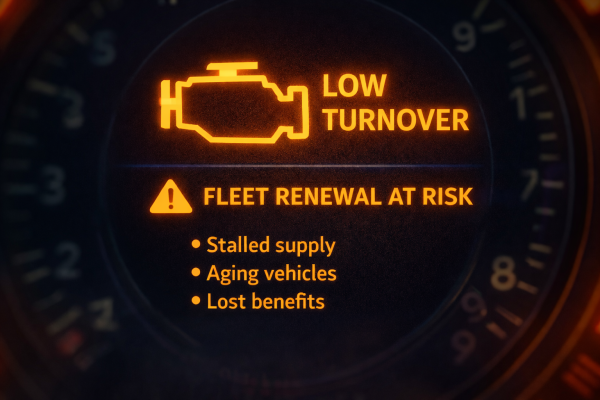
Turnover is the quiet workhorse of progress. It is how newer, lower-emitting vehicles with better safety systems actually make their way into the driveways of ordinary Kiwi households. When turnover is healthy, older vehicles leave the fleet and are replaced by newer ones. When turnover is squeezed, the fleet doesn’t stand still — it ages. The tail of older cars gets longer, maintenance gets deferred, and gains in CO₂ and safety arrive more slowly than policy settings assume.
The 2025 market data gives us a clear picture: the used market kept moving, but the part of the system that matters most for renewal — the supply of “new-to-NZ” used imports — tightened noticeably.
2025: plenty of market activity, but less genuine renewal
On the surface, used-vehicle activity held up. Total used change-of-ownership transactions rose to 996,316 in 2025, up 3.3% on 2024. That tells us people still needed cars and the used market remained active.
But “activity” and “renewal” are not the same thing.
A vehicle can change hands two or three times and the fleet hasn’t improved one bit — it’s still the same vehicle, with the same emissions profile and the same safety feature set. For renewal, what matters is whether older vehicles are being replaced by newer ones. And that’s where the supply signals in 2025 are instructive.
The import pipeline tightened, and that matters because it’s the renewal pipeline
Used imports are not an optional extra in New Zealand. They are a core part of how the fleet refreshes — particularly for households that can’t justify a new vehicle, but still want something safer, cleaner, and more reliable than what they currently drive.
In 2025, the border figures show a clear softening in that pipeline:
-
Total used passenger cars entering NZ fell from 88,469 (2024) to 78,003 (2025) — a drop of 10,466 vehicles (-11.8%).
-
Japan remained the dominant source: 75,480 of the 78,003 used passenger car entries in 2025 came from Japan (about 97%).
Those two facts tell a bigger story. When supply is that concentrated, the market can’t simply shift sourcing when costs rise, or when compliance settings make certain vehicle types uneconomic. There isn’t a deep alternative pool of right-hand-drive, suitable-spec used vehicles sitting elsewhere at scale. New Zealand’s used import sector is, in practical terms, a Japan supply chain market.
So when import numbers drop by nearly 12% year-on-year, that is not just a statistic. It is fewer replacement options landing for the very segments that most households rely on: practical family transport, runabouts, and commuting vehicles.
Tight supply changes behaviour: more re-circulation, less replacement
The 2025 market also showed signs of a system working harder with what it already had. Dealer-to-dealer and public-to-dealer activity lifted strongly, and the “unsold imports” stockholding (“car park”) reduced materially through the year. Read together, those patterns suggest businesses were:
-
running tighter inventory and managing capital more conservatively;
-
moving stock faster once it landed; and
-
relying more on domestic supply churn to meet demand.
None of that is inherently negative — it can be a sign of discipline. But it is also what you expect when the replacement flow tightens: the market re-circulates vehicles already here instead of refreshing the fleet with newer arrivals.
This matters because New Zealand’s fleet improvement curve is not linear. We don’t get broad-based gains from small incremental changes at the top end. We get gains when the mass market can keep stepping forward — from older petrol vehicles to newer petrol vehicles, and increasingly to hybrids and EVs where they suit people’s needs and budgets.
When the used import channel tightens, the step-forward options narrow.
A stalled fleet is not a theoretical risk — the data points in that direction
One of the clearest ways to see renewal pressure is to look at what’s leaving the fleet. In 2025, passenger car and van deregistrations were down compared with 2024. Again, there can be multiple drivers, but the direction is consistent with a familiar pattern: when replacement becomes harder, people keep vehicles longer.
That’s not a moral failing by consumers — it’s rational behaviour. If the next vehicle becomes too expensive, or the right vehicle isn’t available, households delay replacement. They keep the car they’ve got for “one more WOF”, “one more year”, “until rates settle”, “until the next pay rise”.
But collectively, those decisions slow renewal.
Why this matters for policy design
VIA’s point has never been that we shouldn’t reduce emissions. It’s that we need policy settings that keep the renewal engine running, because renewal is how emissions reduction actually becomes real at scale.
The data also reinforces a practical distinction policy makers need to keep in mind: the new vehicle market and the used import market are structurally different.
-
The used import market is auction-supplied, exchange-rate exposed, and highly sensitive to per-vehicle compliance costs.
-
Supply is concentrated (Japan is effectively the pipeline).
-
The customer base is largely households and small businesses buying on affordability, not corporate procurement cycles.
That doesn’t mean used imports should get a “free pass”. It means regulatory measures should reflect the reality of the supply chain and the role it plays in fleet renewal — especially for people who cannot access the benefits of new vehicles.
The core message: turnover is progress
If we want a fleet that improves, we need policy settings that keep turnover flowing. Not reckless turnover — healthy turnover. A market where:
-
the replacement pipeline stays open,
-
compliance costs don’t unintentionally choke supply in the segments households actually buy, and
-
consumers can keep stepping forward rather than being forced to hold back.
Because turnover is where three national objectives quietly meet:
-
CO₂: renewal replaces older, higher-emitting vehicles with newer, more efficient models — and increasingly, hybrids and EVs where they make sense.
-
Safety tech uptake: newer vehicles are far more likely to have modern safety features (and the benefits are only realised when those vehicles are widely adopted, not when they sit at the top end of the market).
-
Affordability for families: used imports are a bridge that allows everyday households to access “newer and better” without paying “brand new” prices.
If turnover is stifled, the fleet doesn’t magically improve anyway. It gets older, it gets harder to maintain, and progress slows. If turnover is supported, the market does what it has always done best: it takes whatever the world is producing — cleaner engines, better safety, new technology — and it steadily works those gains into the real vehicles New Zealanders drive every day.