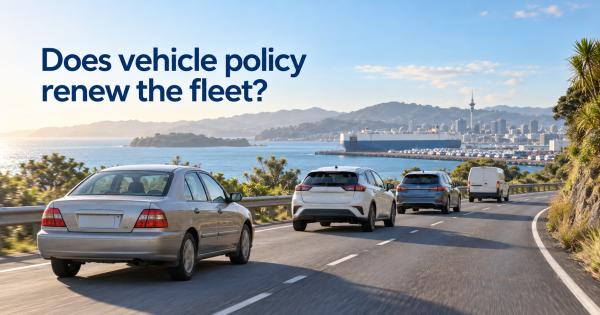
The real test of vehicle policy: does it renew the fleet?
Vehicle policy is often judged at the border.
Does a vehicle meet the required emissions standard? Does it have the prescribed safety technology? Is its gross vehicle mass recorded correctly? Has it passed the required inspections?
These are important questions. But they are not the ultimate measure of whether vehicle policy is working.
The real test is what policy does to the whole New Zealand fleet. Does it help households and businesses replace older vehicles with newer, safer, and cleaner ones? Or does it increase prices, reduce choice, and encourage people to keep their existing vehicles for longer?
That distinction matters because New Zealand has an old vehicle fleet, and fleet renewal does not happen by regulation alone. It happens when people can afford to replace the vehicles they already own.
Fleet renewal is the missing measure
Most vehicle policies are developed around a particular objective. An emissions rule is intended to reduce carbon dioxide or harmful exhaust emissions. A safety requirement is intended to reduce deaths and serious injuries. An inspection rule is intended to prevent structurally unsafe vehicles from entering the fleet.
VIA supports those objectives. The question is whether the proposed rule will achieve them in the real New Zealand market.
A requirement may improve the specifications of vehicles entering the country while also reducing the number of households able to replace much older vehicles. If the second effect is large enough, the policy may deliver less safety or environmental benefit than expected.
That is why the effect on fleet renewal must be considered alongside the standard applying at the border.
New and used vehicles come through different supply chains
New Zealand does not have one vehicle supply market.
New-vehicle distributors source current production from global manufacturers. They can engage with manufacturers over future specifications, although they still face international production priorities and the limitations of New Zealand’s relatively small market.
Used-vehicle importers primarily select from vehicles already manufactured for, sold in, and used in Japan. They cannot ask a manufacturer to add a feature or produce a different model. Their future supply is largely determined by decisions made in the Japanese market years earlier.
Japan’s inspection, taxation, and ownership settings encourage earlier vehicle turnover. This gives New Zealand access to well-specified used vehicles that still have a substantial useful life ahead of them. It has also allowed technologies such as hybrid drivetrains and advanced safety systems to reach New Zealand households at prices that are affordable.
Policy needs to recognise that difference. A requirement that can be incorporated into new production from a future date cannot necessarily be applied to used vehicles on the same timetable.
The Government’s decision to develop separate Clean Vehicle Standard targets for new and used imports is an important recognition of this reality. The next step is to ensure the used-vehicle settings are based on evidence about the vehicles that will actually become available from Japan, not simply the new-vehicle trajectory shifted back by an arbitrary number of years.
Affordability is part of safety and environmental policy
Affordability is sometimes presented as competing with safety or emissions reduction. In reality, it is one of the mechanisms through which those outcomes are achieved.
A household that can replace a 20-year-old vehicle with a substantially newer used vehicle is likely to gain improved crash protection, better fuel economy, lower harmful emissions, and more modern safety technology.
The replacement vehicle does not have to represent the latest available technology to provide a meaningful improvement. Fleet renewal works through a series of practical steps.
If regulation pushes suitable replacement vehicles beyond the household’s budget, the older vehicle may remain in use. Its replacement may be deferred for several years, or it may be replaced by another vehicle of a similar age.
The same issue applies to small businesses, tradespeople, and transport operators. A newer vehicle can improve safety, reliability, fuel efficiency, and productivity, but only if the business can finance the change.
This does not mean standards should stand still. It means their timing and design should support a transition that the market can realistically deliver.
Good objectives still require good implementation
Several current policy issues demonstrate the need for a whole-of-fleet view.
Further cost-benefit analysis of proposed advanced driver assistance system requirements should consider more than the benefit of the technology itself. It should also examine its prevalence in relevant Japanese vehicle age groups, the likely effect on supply and prices, and whether reduced access to replacement vehicles could offset some of the expected benefit.
Damage and corrosion inspections must identify vehicles requiring repair or further specialist assessment. However, overly sensitive border flagging can add cost and delay where subsequent inspection finds that repair certification is unnecessary. A well-designed system should target genuine structural risk and produce consistent decisions across the supply chain.
The new gross vehicle mass position for imported heavy vehicles provides greater clarity about the evidence that determines a vehicle’s rating. It also shows why rules must reflect how vehicles were originally manufactured, certified, and operated in their previous market.
These issues differ in detail, but they raise the same fundamental question: will the policy produce a better fleet, or merely a tighter gateway?
A practical test for future vehicle rules
VIA believes significant new vehicle requirements should be assessed against five questions:
-
Is the benefit measurable?
The intended safety or environmental improvement should be clearly defined, supported by evidence, and capable of being evaluated after implementation. -
Are suitable vehicles actually available?
Analysis must reflect the vehicles produced for and released from the relevant source market, including their age, price, specifications, and likely future volumes. -
Is the timetable realistic?
New and used supply chains require different lead times. Implementation should reflect those differences rather than applying a superficially uniform date. -
What will happen to affordability and choice?
Regulatory impact analysis should identify likely changes in vehicle prices, supply volumes, market segments, and access for lower-income households and small businesses. -
Will the policy accelerate or slow fleet renewal?
The assessment should consider not only the vehicles entering New Zealand, but also the older vehicles they could replace.
These questions do not weaken safety or environmental ambition. They help ensure that ambition translates into real-world gains.
Looking beyond the border
New Zealand needs a safer, cleaner, and more efficient vehicle fleet. Achieving that will require increasingly capable new vehicles, a strong supply of affordable later-model used vehicles, workable inspection and certification systems, and the steady retirement of older vehicles.
No single policy will deliver that outcome.
The best vehicle policy will set clear objectives, recognise how different supply chains operate, and monitor its effect on the whole fleet. It will allow standards to rise while preserving realistic pathways for households and businesses to upgrade.
The number of vehicles that pass through the border is easy to measure. The more important question is whether policy helps New Zealanders move into better vehicles.
That should be the real test.