
Lower penalties do not mean lower prices

Recent coverage of the impact of the Government’s decision to relax Clean Car Standard penalty settings has created a simple public expectation: if penalties go down, used car prices should go down too.
That sounds logical on the surface. If a cost is removed from the system, surely that saving flows straight through to buyers — or gets pocketed by industry as profit if it doesn’t.
But that is not how the used vehicle market in New Zealand actually works.
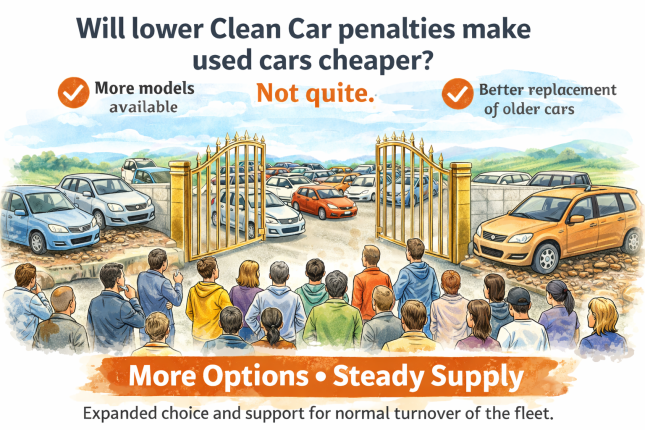
What the change really does is something more important — and more practical — for Kiwi households: it restores choice, stabilises supply, and helps keep the vehicle fleet moving forward through normal replacement and renewal.
The common misunderstanding
The public narrative tends to assume a direct chain:
Lower penalties → lower import costs → lower retail prices
In reality, the used vehicle market doesn’t operate like a cost-plus retail model where prices simply follow input costs.
Instead, it is a budget-constrained market.
Most everyday buyers operate within relatively tight affordability bands. For many households, that sits roughly in the $10,000–$12,000 range. When prices push above what buyers can afford, they generally don’t stretch upward indefinitely. They adjust behaviour instead.
They might:
- buy an older vehicle
- choose a smaller vehicle
- accept higher mileage
- delay purchase
- stay in their existing vehicle longer
In other words, the market clears around what households can pay, not around what importers would like to charge.
That means lowering one cost component does not automatically translate into lower sticker prices. It changes what vehicles can be offered — not what buyers are able to spend.
What the higher penalty actually did
Under the previous, much higher penalty rate, a number of vehicles simply became commercially unviable to import.
That did not mean demand for those vehicles disappeared. Families still needed people movers. Tradespeople still needed practical vehicles. Buyers still wanted particular price-feature combinations.
But many of those vehicles could no longer be supplied.
The result was predictable:
- the range of vehicles available to consumers narrowed
- importers shifted toward only certain vehicle types
- supply became tighter and more fragile
- replacement of older vehicles slowed
- pressure built up in the existing fleet
When supply narrows in a budget-constrained market, the adjustment is not falling prices — it is reduced choice and delayed replacement.
What the lower penalty changes
Reducing the penalty rate eases regulatory cost pressure. That makes more vehicles commercially viable to import again.
The key effects are:
- more models and vehicle types returning to the market
- improved availability of family and mid-range vehicles
- less pressure forcing buyers into very limited options
- reduced risk of sudden price spikes caused by supply shortages
- greater stability for importers planning stock
That is why the most accurate description of the change is:
Greater variety of used import vehicles returning to the market.
This is especially important for high-demand family vehicles. Several popular people movers — including models such as the Nissan Serena, Toyota Alphard, Toyota Vellfire, Honda Odyssey and Toyota Estima — become significantly more viable to supply when regulatory cost pressure is reduced. That translates directly into more practical choices for households.
Why this matters for the fleet as a whole
Vehicle markets only function properly when there is steady throughput and turnover.
Newer replacement vehicles enter. Older vehicles exit. Households can trade up, trade across, or replace vehicles that are no longer fit for purpose.
When supply is throttled, that cycle slows down.
People hold onto older vehicles longer — including vehicles that are:
- less safe
- higher emitting
- less reliable
- more expensive to maintain
Restoring supply helps the normal replacement cycle resume. That allows people to move out of less desirable vehicles and into better ones, at price points they can actually afford.
That is how real fleet improvement happens in a country like New Zealand — not through sudden price drops, but through steady renewal and practical choice.
What actually drives used vehicle prices
Retail prices in New Zealand are shaped primarily by:
- household income constraints
- exchange rates
- auction prices in Japan
- shipping costs
- finance conditions
- overall supply availability
Regulatory penalties are only one factor — and not the dominant one.
Reducing penalty pressure helps keep vehicles viable to supply. It does not create a windfall discount mechanism.
The more accurate way to understand the change
We can't really say: “Penalties fell, so prices will fall.”
A more realistic explanation is:
Reducing penalty rates lowers regulatory cost pressure, which helps preserve affordability and expand vehicle choice — but actual prices remain determined mainly by what Kiwi households can afford and by global supply conditions.
What this means for consumers
For everyday buyers, the real benefit is straightforward:
- more vehicles to choose from
- more practical family options
- fewer supply bottlenecks
- greater market stability
- a healthier replacement cycle
In short, the change supports access — not discounts.
And for a country where most households buy used vehicles out of necessity rather than luxury, access and choice are what matter most.